
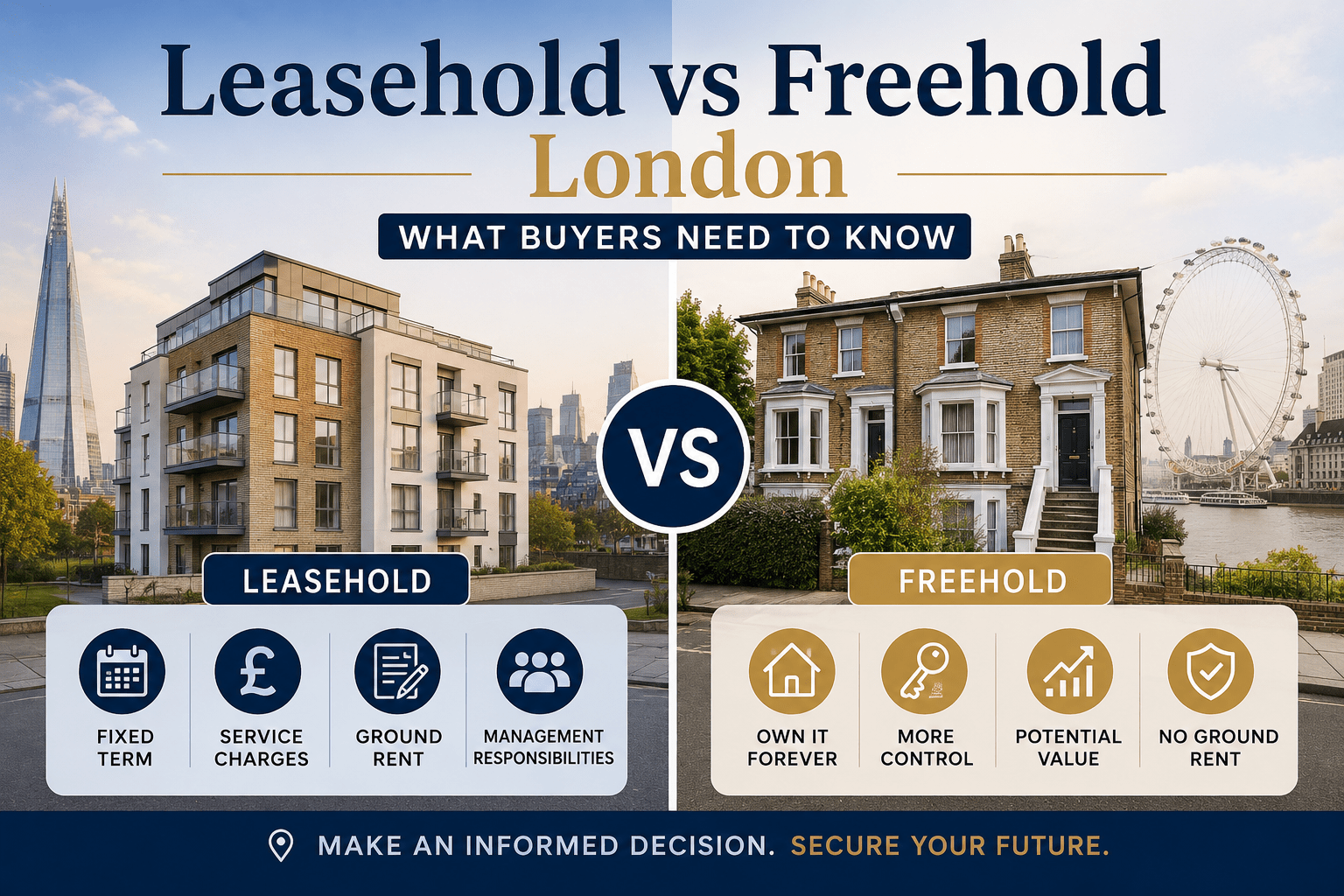

Leasehold vs Freehold London | What Buyers Need to Know
Leasehold or Freehold: A London Buyer's Decision Guide
The first decision every London buyer faces, often without realising it, is whether to buy leasehold or freehold. Most flats in London are leasehold. Most houses are freehold. But there are exceptions, and the decision has long-term financial consequences that the property listing rarely makes clear.
Here is what each one actually means and what to check before you buy.
What freehold means
You own the property and the land it sits on, forever. There is no landlord above you, no ground rent, no service charge in most cases, and no fixed-term lease ticking down. You are responsible for the building, the roof, the boundaries, and the maintenance, but you make the calls and pay your own costs.
Almost all standalone London houses are freehold. The exception is purpose-built mews developments and gated estates, where the freehold may sit with a residents’ company.
What leasehold means
You own the right to live in the property for a fixed period — the lease — and someone else owns the freehold of the building and the land. The leaseholder (you) pays ground rent and service charges to the freeholder, who is responsible for the building structure, communal areas, and insurance.
Most London flats are leasehold because flats sit inside buildings that need someone to manage the shared parts. Houses that are leasehold do exist (especially in older estate developments) but they are relatively rare and worth scrutinising.
The four questions that decide everything
1. How long is the lease?
This is the single most important number. Leases under 80 years are problematic. The reason is marriage value — once a lease drops below 80 years, the cost of extending it jumps significantly because the freeholder is entitled to half the increase in value the extension creates. Mortgage lenders also get nervous about leases under 80 years and may decline to lend.
If a flat is listed with a lease under 90 years, factor in the cost of an extension before you offer. Extending typically costs anywhere from £5,000 to £50,000+ depending on the property value and the years remaining.
2. What is the ground rent?
For leases granted before mid-2022, ground rent can be substantial and can include escalation clauses where it doubles every ten years. Some leases written between 2007 and 2022 have escalation terms that make the property effectively unsellable down the line. Get the exact ground rent figure and any review clauses before you offer.
For new leases granted after the Leasehold Reform (Ground Rent) Act 2022 came into force, ground rent on most new residential leases is capped at one peppercorn — effectively zero. Verify the current state of leasehold reform legislation before publishing — this area has had multiple bills in recent years.
3. What does the service charge cover and what does it cost?
Service charges cover building insurance, communal cleaning and lighting, lift maintenance, reserve fund contributions, and management company fees. They vary wildly. A small purpose-built block might charge £1,500 a year. A new-build with a concierge, gym, and roof terrace might charge £6,000 to £15,000 a year. A grand period mansion block can cost more.
Ask for the last three years of service charge accounts. Look for upward trends, big one-off items, and any planned major works (lift replacements, roof works, external decoration cycles) that could trigger a section 20 charge in the next few years. Section 20 charges can run to tens of thousands of pounds per flat.
4. Who is the freeholder and who manages the building?
Some buildings are managed by professional managing agents working for an absent investor freeholder. Others are managed by residents themselves through a Right to Manage company or share-of-freehold structure. The second is generally better — residents have more control over costs and decisions.
If the freeholder is a foreign investment vehicle or a shell company you cannot easily contact, factor that into your decision.
Share of freehold: the middle option
Some London flats are sold with a “share of freehold” — meaning the leaseholders collectively own the freehold of the building through a residents’ company, and each flat owner holds a share of that company plus a long lease (often 999 years) on their flat.
This is usually the best of both worlds: long lease, low or zero ground rent, residents control management decisions, and major works are agreed collectively. If you have the choice between a leasehold flat and an equivalent share-of-freehold flat, the share of freehold is almost always worth more, even at a slightly higher price.
When to walk away
A leasehold flat is not worth the trouble if:
- The lease is under 80 years and the seller will not extend before completion or reduce the price to cover an extension
- Ground rent doubles every ten years or twenty-five years
- Service charges have jumped more than 50% in three years with no clear reason
- The freeholder is unresponsive, or there are unresolved disputes between leaseholders and the freeholder
- Major works are planned and not disclosed
Get advice before you offer
Leasehold checks are technical and easy to skip when you are excited about a flat. Talk to us before you offer on any leasehold property. We can read the lease summary, flag risks, and tell you whether the asking price reflects the lease situation or ignores it.